Insurance by operating model
Commercial HVAC Contractor Insurance
Insurance for the commercial and mechanical HVAC contractor — rooftop units, building systems, large and industrial install, and mechanical work run under general-contractor relationships. The commercial-project model, where rooftop and height exposure, bigger jobs, and contract insurance requirements drive the risk profile.
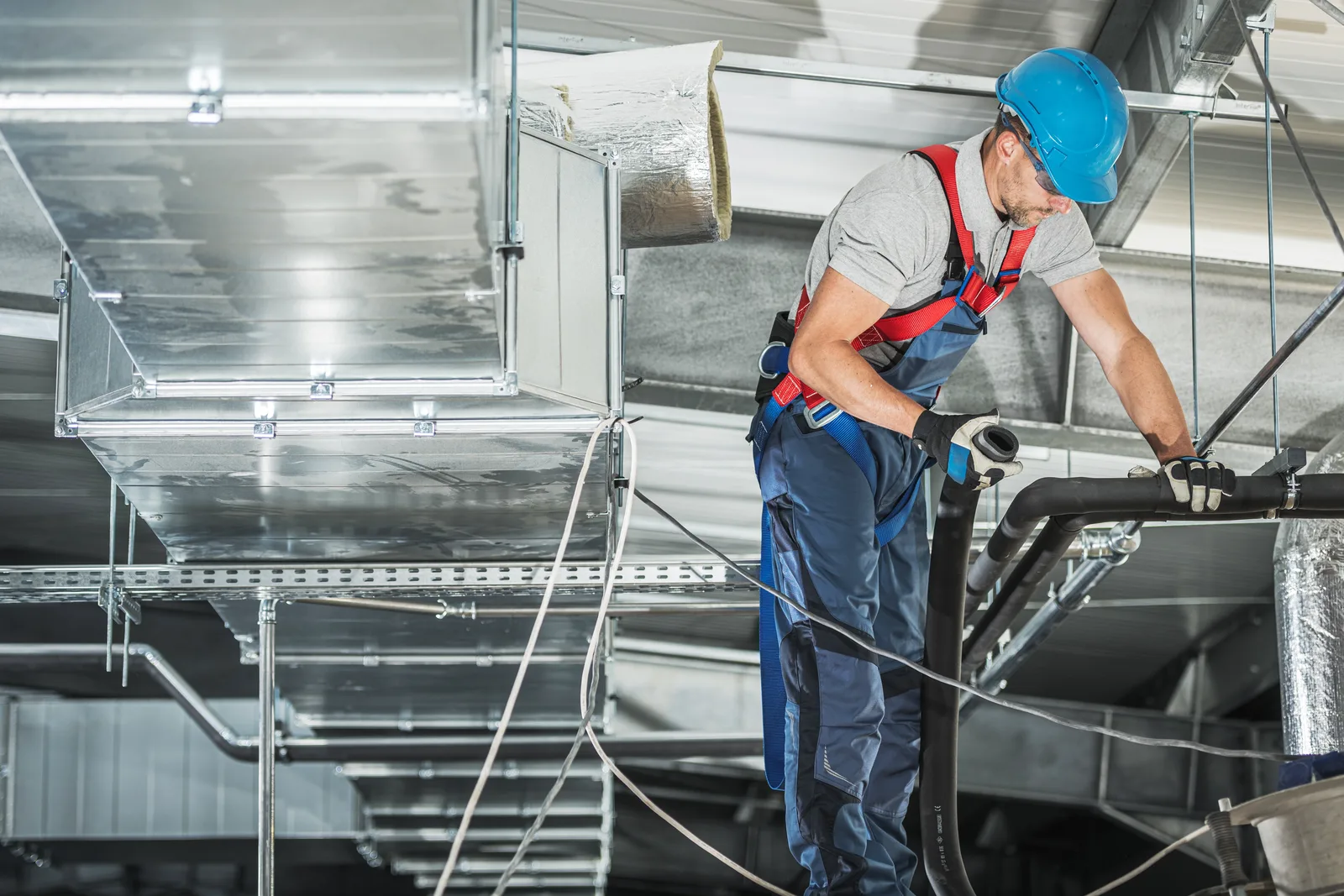

Commercial HVAC is its own operating model, not a coverage line — and what makes its insurance distinct is the scale of the work and the contracts it runs under. A commercial and mechanical operation sets rooftop units, installs and services building systems, runs large and industrial mechanical work, and takes on new-construction and retrofit projects — usually as a subcontractor to a general contractor, on a building rather than in a home. That setting changes everything about the risk: the work happens at height, the jobs and the potential losses are bigger, and the contracts impose insurance requirements a residential service operation never sees. The coverage has to be built for height, scale, and contract.
Three exposures define the commercial model. The first is rooftop and height work. Setting and servicing rooftop units, working on a building’s mechanical plant, and rigging equipment to a roof put crews at height, and a fall is among the most serious claims in the trade — a workers compensation exposure that residential service largely does not carry. The second is the larger completed-operations tail: when a commercial install fails after the job, the claim can reach a whole building, its occupants, and the broader project, not a single home, which is why general liability is written here at higher limits and backed by an umbrella. The third is the general-contractor relationship — additional-insured status, certificates of insurance, completed-operations requirements, and total limits set by the contract, which is where umbrella liability earns its place.
Two more exposures come with commercial-scale work. The equipment is heavier and often supplemented by rented lifts and cranes, running through contractors equipment and the rented-equipment terms that come with it. And the crews and the project vehicles moving to and around commercial sites run through workers compensation and commercial auto. The bigger the job, the more each of these scales.
This page covers how commercial HVAC insurance is built for the project model: what the model is and the work it covers, the height/scale/contract risk profile, the coverage stack it needs, the drivers that move cost, and how carriers underwrite it. Commercial does not lead with the in-home service profile — if your operation also runs residential service and replacement, the Residential HVAC Contractor Insurance page is built for that model.
Running commercial and mechanical HVAC? Get a quote built around your rooftop work, your project scale, and the contract limits you have to meet.
Get a Free QuoteWhat makes commercial HVAC insurance different
Commercial risk is height-and-scale-and-contract risk, and it lands on the coverage stack differently than a service operation’s. General liability carries more weight and higher limits because the completed-operations exposure of a building system is larger than a home’s, and umbrella liability moves from optional to essential because general contractors and building owners require total limits above a standard primary policy. Workers compensation carries the rooftop and height exposure that drives the most serious injuries, and contractors equipment has to account for heavier owned gear and the rented lifts and cranes a rooftop job leans on. A policy rated to a generic service business meets none of these at the level commercial work demands. For how the umbrella decision plays out as a shop moves into commercial work, see when an HVAC business needs an umbrella policy.
The practical consequence is that the contract often dictates the coverage. A commercial bid can hinge on whether you can produce a certificate naming the general contractor as additional insured, carry completed-operations status, and meet a required total limit — and an operation that cannot is off the job before the work starts. We read the insurance requirements in the contracts you are bidding and build the program to satisfy them, rather than discovering a limit or endorsement gap after you have won the work.
The work this covers
The commercial model holds several kinds of work that share one risk profile — crews at height on a building, larger systems, and a general-contractor relationship with contractual insurance requirements. These are the services that live within this pillar:
- Rooftop units (RTUs). Setting, replacing, and servicing packaged rooftop units — the signature commercial work, carrying the height and rigging exposure that defines the model.
- Building systems and mechanical. Installing and maintaining a building’s HVAC and mechanical plant — chillers, air handlers, boilers, and the distribution that serves a whole building.
- Large and industrial install. New-construction and retrofit mechanical installs on commercial and industrial buildings — the work with the deepest completed-operations tail and the heaviest contract requirements.
- Commercial service and retrofit. Servicing and upgrading systems in occupied commercial buildings — the access, scale, and tenant exposures of working in a live building.
In-home residential service and replacement is not part of this model — it carries its own smaller-scale, high-volume profile and lives on the Residential HVAC Contractor Insurance page. If your operation runs both, each scope is underwritten on its own terms.
State and regulatory considerations
Commercial HVAC sits at the intersection of refrigerant regulation, contractor licensing, and worker safety — with the height exposure putting worker safety front and center. The federal floor is the EPA Section 608 certification under the Clean Air Act, the technician credential required to handle refrigerants, consistent across states. Separate from that federal credential is the state or local HVAC/mechanical contractor license — a patchwork where some states license mechanical contractors at the state level, some through a general contractor regime, and some at the municipal level, and commercial projects often add their own permitting and prevailing-wage or licensing conditions on public work. Worker safety, especially fall protection for rooftop and height work, runs through OSHA standards, and a documented safety program matters both for crews and for qualifying on commercial bids.
On top of the federal layer, workers compensation rules vary by state — including the four monopolistic states where coverage comes only from the state fund, which matters for an operation taking projects across state lines. As our state pages come online we link the licensing, regulatory, and worker-safety specifics for the states we serve. We write across all 48 licensed states, with priority markets including Texas, California, Florida, New York, and Illinois.
Coverage breakdown
Here is the stack a commercial HVAC operation carries, weighted for the project model. Each line links to its full page — and general liability at higher limits, backed by an umbrella, is the signature placement for this model.
- General Liability Insurance — the signature line at higher limits: third-party injury and property damage on commercial sites, and the larger completed-operations exposure when a building system fails after the job. The general liability page covers the completed-operations mechanism in full.
- Umbrella Liability Insurance — essential for commercial work: the excess limits general contractors and building owners require above your primary general liability and commercial auto, and the protection against a catastrophic building-scale loss.
- Workers Compensation Insurance — medical and lost-wage coverage carrying the rooftop and height/fall exposure that drives the most serious commercial HVAC injuries, structured for crews that may work across state lines.
- Contractors Equipment Insurance — the heavier owned gear plus the rented lifts and cranes a rooftop job leans on, insured as inland marine with the rented-equipment terms read against your contracts.
- Commercial Auto Insurance — the trucks and vehicles moving crews and gear to and around commercial job sites, including hired and non-owned exposure on larger projects.
What commercial HVAC insurance costs
Premium tracks the scale and the contracts, not a sticker price. The drivers that move it most are your payroll and the technician classifications it covers, how much of your work is at height and on rooftops, the size and type of the projects you take and their completed-operations exposure, the total limits your contracts require, your owned and rented equipment, your multi-state footprint, your safety program, and your claims history — particularly any fall or completed-operations losses. An operation doing large rooftop and industrial install under demanding general-contractor requirements looks very different to an underwriter than one doing lighter commercial service. We price to that real picture and stand behind any figure we give — verified ranges come from us directly, never a generic guess.
Claims scenarios
These are plausible commercial HVAC claim categories, described qualitatively and with generic carrier language — every claim is handled by the carrier, never named here — and with no fabricated cost or frequency figures.
- A failed rooftop or building-system install. A commercial system fails after the job and the completed-operations claim reaches the building, its occupants, or the broader project — the larger-scale completed-operations exposure, answered by general liability at higher limits.
- A fall from a roof or at height. A technician is injured working on a rooftop unit or at height on a building — among the most serious workers compensation claims in the trade.
- A dropped tool or component from height. A tool, part, or unit dropped from a roof damages property or injures someone below — a serious third-party general-liability exposure unique to height work.
- A contract limit or additional-insured gap. A general contractor pulls a crew off a site, or withholds payment, because the certificate or limit on file does not meet the contract — a business loss avoided by building the program to the contract up front.
Underwriting realities
Carriers writing the commercial HVAC class look at the scale and the discipline: payroll and classifications, the share of rooftop and height work, the size and completed-operations exposure of your projects, your safety and fall-protection program, your owned and rented equipment, your subcontractor controls, and your loss history. A documented safety program, strong subcontract and certificate discipline, a clean fall and completed-operations record, and the ability to meet additional-insured and limit requirements open more markets; a serious fall or building-scale completed-operations loss narrows them. Operations that also run a residential service division get that portion underwritten separately so the commercial project book is not mispriced against it. We position your operation to the carriers most likely to want a commercial and mechanical risk rather than sending one generic submission everywhere.
Why HVAC Guard Insurance
We write one trade — residential and commercial HVAC contractors — and within it we treat commercial as the height, scale, and contract operation it is. We weight your stack toward general liability at higher limits and an umbrella, read the completed-operations exposure against the building-scale work you take, structure workers compensation around the rooftop and height risk, account for rented lifts and cranes on the equipment line, and set the additional-insured and certificate language to satisfy the general contractors and building owners you work for. We place coverage with carriers that want the commercial HVAC class. Start with a quote, or send us a contract’s insurance requirements and we will tell you what limits and coverage it requires.
Learn more
Commercial is one of two HVAC operating models, and the coverage stack shifts with the work. The signature placements for this model live on the general liability and umbrella liability pages, with workers compensation carrying the rooftop exposure. If your work is in-home residential service and replacement instead, the Residential HVAC Contractor Insurance page leads with the in-home and service-volume profile that model carries, and the HVAC insurance services overview explains how the two differ.
For the program both operating models share, see HVAC contractor insurance.
Coverage for commercial HVAC contractors
- General Liability Insurance
- Commercial Auto Insurance
- Workers Compensation Insurance
- Contractors Equipment Insurance
- Umbrella Liability Insurance
HVAC operating models
Get covered
Primary sources
Frequently asked questions about Commercial HVAC Contractor Insurance
What insurance does a commercial HVAC contractor need?
A commercial HVAC contractor typically carries general liability, an umbrella, workers compensation, commercial auto, and contractors equipment. The weight sits on general liability at higher limits — for the larger completed-operations exposure of a failed system on a whole building — and on an umbrella, because general contractors and building owners routinely require total limits above a standard primary policy. Workers compensation carries extra weight for the rooftop and height exposure, and contractors equipment for the heavier gear and rented lifts. We build the stack around the scale of your jobs and the contracts you sign.
How is commercial HVAC insurance different from residential?
The work, the scale, and the contracts are different. Commercial and mechanical HVAC means rooftop units, building systems, large and industrial install, and mechanical work — bigger jobs, height and fall exposure, and a completed-operations tail that can reach a whole building rather than a single home. It also runs under general-contractor relationships that impose insurance requirements: additional-insured status, certificates of insurance, and higher total limits. Residential is the in-home service-and-replace model with a different, smaller-scale profile. We write each to its own model rather than off one generic contractor form.
Why do general contractors and building owners require specific insurance from us?
Because your work on their building can produce a claim that reaches them, so they push that risk down through the contract. A commercial general contractor, building owner, property manager, or facility account commonly requires you to name them as additional insured, carry completed-operations status, provide a certificate of insurance before you start, and meet a total limit often higher than a standard primary policy carries. Miss the requirement and you can lose the job or be pulled off the site. We set the additional-insured and certificate language to match the contract and reach the required limits, usually by pairing general liability with an umbrella.
How does the height and rooftop exposure affect coverage?
It concentrates the workers compensation and liability exposure. Setting and servicing rooftop units and working at height on commercial buildings carries a fall exposure that residential service largely does not, and a fall is among the most serious workers compensation claims in the trade. It also raises the general-liability stakes — a tool or component dropped from a roof, or a crane or lift incident, is a serious third-party exposure. We classify the payroll to the real work, structure the comp around the height exposure, and read the liability and equipment lines against rooftop and mechanical work rather than a generic service profile.
Why does completed operations carry higher limits on commercial work?
Because the scale of the loss is bigger. When a commercial install fails — a rooftop system, a building’s mechanical plant, an industrial unit — the completed-operations claim can involve a whole building, its occupants, and a general contractor’s broader project, not a single home. The tail is the same idea as residential, but the potential severity is much higher, which is why commercial work is written at higher general-liability limits and backed by an umbrella. We size the completed-operations limits and the umbrella to the scale of the jobs you take.
Does commercial HVAC insurance also cover residential service work?
Not automatically, and that is by design. Commercial and mechanical work is the rooftop, building-systems, and large-install model with its height, scale, and contractual exposures. Residential service and replacement — in customers’ homes, smaller units, high service-call volume — is a genuinely different operating model. If your operation runs both, the residential HVAC contractor page is built for that model, and we underwrite each scope on its own terms so neither is mispriced.
Do you cover new construction and retrofit mechanical work?
Yes — new-construction and retrofit mechanical installs are core to the commercial model, and they bring the deepest completed-operations exposure and the heaviest general-contractor requirements. New construction puts you in a project structure with a general contractor, a schedule, and strict insurance and additional-insured requirements; retrofit work puts you into an occupied building with its own access and damage exposures. We structure the coverage and the certificate and additional-insured language to the project and the contract, rather than treating a building project like a service call.
Insure your commercial operation to the contract
Tell us about your rooftop and mechanical work, your project scale, and the limits your contracts require, and we will market it to carriers that write the commercial HVAC class.