States we serve · Tennessee
Tennessee HVAC contractor insurance
Tennessee’s Board for Licensing Contractors sits inside the Department of Commerce and Insurance, and its HVAC license — the CMC-C classification, with a monetary limit per project — is issued only with general liability sized to that limit and workers’ comp or proof of exemption. Because Tennessee requires construction businesses to cover their owners unless they join the state’s exemption registry, we build each Tennessee program around the license file and the registry: liability for heat-pump, duct and furnace work, comp, auto, equipment and umbrella limits.

Tennessee regulates HVAC contractors through an unusual pairing: the Board for Licensing Contractors is part of the same Department of Commerce and Insurance that regulates the insurers writing your policy, and the board treats insurance as part of the license. A contractor’s license is required to bid or contract for projects at or above the statutory dollar threshold — including HVAC subcontracts above that threshold — and the application must show general liability based on the license’s monetary limit plus workers’ comp or proof of exemption. The comp rule reaches further for contractors than for other employers: Tennessee’s Bureau of Workers’ Compensation requires construction businesses to cover everyone, owners included, unless an eligible owner is listed on the state’s exemption registry. The housing explains the work: Census data show electricity heating a far larger share of Tennessee homes than nationally, with utility gas well below the national share, and mobile homes are more common than across the country. This page covers the license, the comp and exemption rules, the heat-pump and duct risk picture, and the markets from Memphis to the eastern mountains.
Tennessee HVAC insurance costs
Tennessee HVAC insurance is priced from your operation, not from a statewide rate card. For the drivers an underwriter weighs and how to get an accurate quote, see our guide to how much HVAC insurance costs in Tennessee.
CMC-C, monetary limits and the qualifying agent: Tennessee’s contractor board
The Tennessee Board for Licensing Contractors requires a license before a contractor bids, offers or negotiates a price on a project at or above the statutory threshold as a prime contractor, and it requires an HVAC subcontractor to be licensed when it contracts with another contractor and the HVAC portion reaches that threshold, materials and labor included. HVAC work is licensed under the mechanical classifications: CMC-C is the HVAC classification, while the full mechanical CMC covers plumbing and HVAC and needs the board’s pre-approval to test. Each company names a qualifying agent — an owner, full-time employee or officer — who passes the open-book Business and Law exam and, where the classification requires it, the trade exam. The license carries a monetary limit for each project, set from the reviewed or audited financial statement or, under the board’s newer option, a contractor’s surety bond. Tennessee does not let a contractor work on another state’s license, though it waives the HVAC trade exam for active licensees of certain states, among them Alabama, Ohio and South Carolina’s commercial board. Details are on the Tennessee Board for Licensing Contractors (Department of Commerce and Insurance) site, and the same department’s insurance division, the Tennessee Department of Commerce and Insurance, regulates the carriers.
Insurance in the Tennessee license file
The board’s application asks for general liability insurance based on the monetary limit requested and for workers’ comp unless the applicant provides proof of exemption. Separately, a Home Improvement license is required for residential remodeling projects within a set dollar band in the counties that adopted the law — among them Davidson, Shelby, Knox, Hamilton and Rutherford — and it requires proof of general liability and workers’ comp and a surety bond. Technicians who handle refrigerant also need federal EPA Section 608 certification, which no Tennessee license replaces; our guide to EPA 608 certification as a business asset explains why it matters to a shop.
Owners included: Tennessee’s construction comp rule and the exemption registry
Tennessee’s Bureau of Workers’ Compensation divides employers in two. Businesses outside construction need coverage only once they reach a set number of employees; businesses in the construction industry must cover everyone, including the business owners. HVAC installation, service and repair appears on the Bureau’s contracting codes list — as class code 5537 — which makes an HVAC company a construction services provider under that rule. An eligible construction business owner can apply to be listed on the Tennessee Workers’ Compensation Exemption Registry, but an exempt owner must still insure every employee, even a single one, and the registry is a public list that says nothing about the owner’s license. The same codes list says an HVAC contractor that performs all or a majority of the work on an HVAC contract cannot divide that payroll between class code 5537 and another contracting classification. Private carriers, not an exclusive state fund, write the comp the Board for Licensing Contractors wants to see; our workers compensation page covers how that policy handles an injury.
Tennessee HVAC exposure across a heat-pump state with real winters
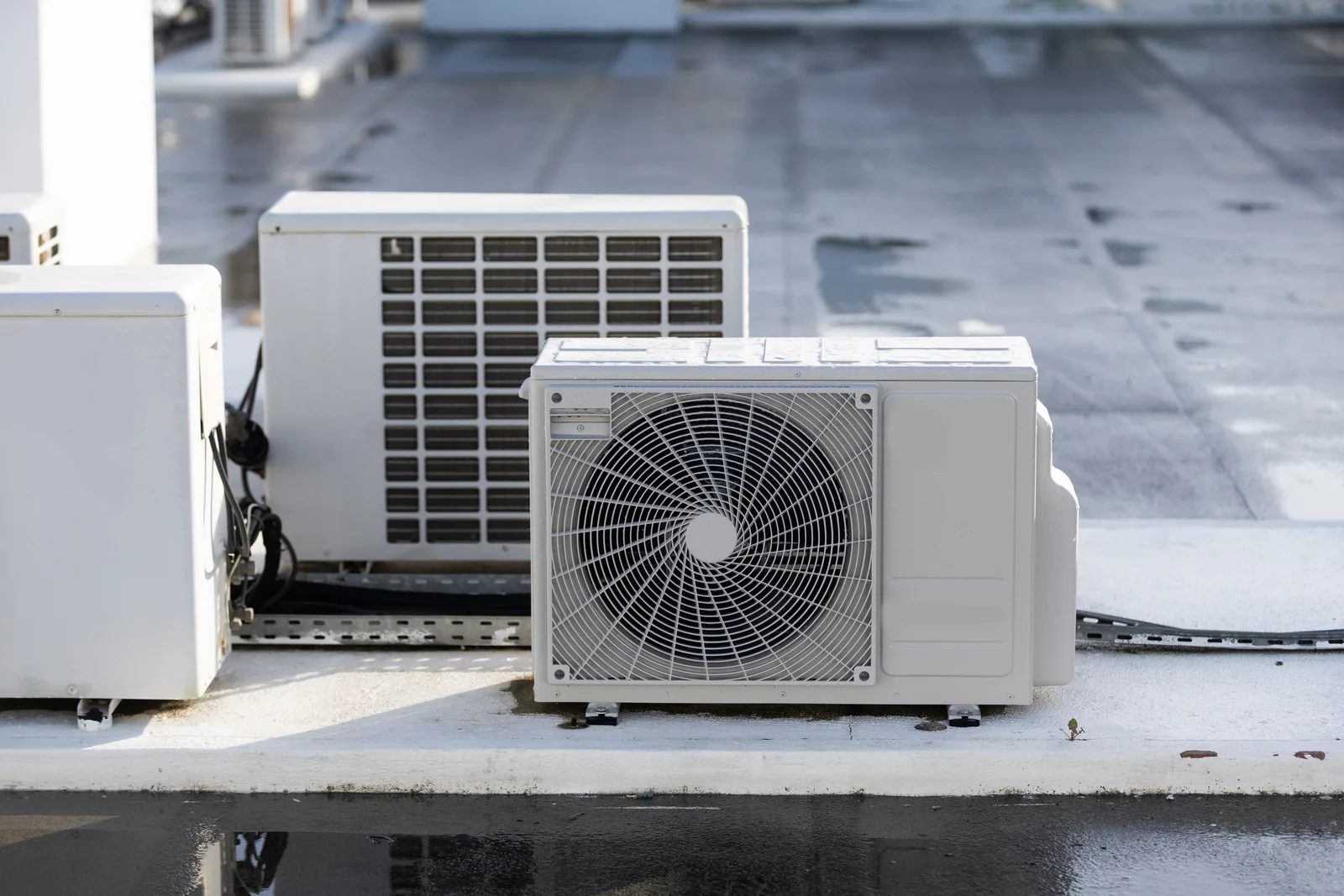
NOAA’s normals for Nashville International Airport show a heating load that still exceeds the cooling load, with the cooling load not far behind, which means a Tennessee shop works hard at both ends of the year. Census data show electricity heating a far larger share of Tennessee homes than it does nationally and utility gas and propane each below the national share, so heat pumps carry both seasons — cooling in humid summers and heating through winters that, per the state’s seasonal profile, bite hardest in the eastern mountains. A heat pump that fails on a cold night, an air handler that leaks into a ceiling, or a crossed control wire behind an electrical fire all land on the contractor after the job. Mobile homes make up a larger share of Tennessee housing than nationally, which adds manufactured-home ductwork and package units to a CMC-C shop’s work, and the housing is newer than the national median. The diagram below sets those exposures against the policies that answer them: heat-pump, duct and furnace work under general liability, the gear in the van under contractors equipment, crews and covered owners under workers compensation, and service vans crossing from Memphis to Knoxville under commercial auto.
Tennessee Seasonal Market
Tennessee pairs hot, humid summers that drive strong air-conditioning and heat-pump demand with genuinely cold winters that keep a substantial heating workload, especially in the eastern mountains.
The honest framing: Tennessee is a true two-season state, with a real heating season beside its long, humid summers. Middle and west Tennessee around Nashville and Memphis run hot and humid with strong air-conditioning demand, while the eastern mountains around Knoxville and Chattanooga carry genuinely cold winters and a larger heating workload. That spread is why we weight each operation’s coverage to where and how it actually works rather than to a statewide average.
Tennessee heat-pump, duct and furnace losses
These are the Tennessee losses we shape coverage around.
- A heat pump or air handler that fails after a Nashville install — a condensate or refrigerant-line problem that damages ceilings and floors weeks later falls to the products-completed operations part of general liability.
- Crushed or disconnected ductwork under a Tennessee mobile home — with mobile homes a larger share of Tennessee housing than nationally, belly-duct and crossover work that fails can lead to moisture and floor damage, again under general liability.
- A gas furnace vent left wrong in Knoxville or Chattanooga — in East Tennessee, where the state’s seasonal profile puts the heaviest heating load, a flue failure after the job can mean carbon monoxide or fire.
- An owner hurt on the job without coverage — Tennessee requires construction business owners to be covered unless they are on the exemption registry, so an owner-installer’s fall from a Memphis roof is a workers compensation question before it is a medical bill.
- A van accident or stolen gauges between Clarksville and Murfreesboro — the commercial auto and contractors equipment side of a Middle Tennessee route.
Built around your Tennessee license limit and exemption status
We start from the Tennessee license file: the general liability limit the board expects for your monetary limit, the certificate the application needs, and the renewal paperwork that follows. If an owner is on the exemption registry, we confirm the exemption is current and write comp for every employee anyway, as the Bureau requires; if not, we cover the owners as Tennessee construction rules demand and classify the payroll under class code 5537 without improper splits. For residential shops in Davidson, Shelby, Knox, Hamilton or Rutherford County, we match the general liability and comp to what a Home Improvement license needs, and for heat-pump installers across Middle and East Tennessee we write completed-operations limits that follow equipment running year-round.
Major Tennessee HVAC Markets
Tennessee is not one market — it spans a fast-growing middle Tennessee, a humid west, and a mountainous east with real winters, each with its own cooling and heating mix. These are the major HVAC submarkets we place across.
Nashville
A fast-growing metro where commercial build-out and residential development drive both install and service demand. Hot, humid summers anchor cooling and heat-pump work, while real winters add a meaningful heating workload.
Memphis
A west-Tennessee hub with commercial, distribution, and mechanical work alongside a deep residential service base. Hot, humid summers drive a heavy cooling load.
Knoxville
An east-Tennessee market where university, institutional, and commercial mechanical work meets a residential service base. Humid summers drive cooling demand while cold mountain winters carry real heating work.
Chattanooga
A river-and-mountain metro with commercial and industrial mechanical work and a residential replacement base. Hot summers drive cooling load alongside a genuine winter heating season.
Clarksville
A fast-growing market with residential development and commercial and institutional mechanical work. Hot, humid summers anchor cooling demand with real winter heating work.
Murfreesboro
A growing middle-Tennessee market in the Nashville orbit with residential build-out and commercial mechanical demand. Humid summers drive cooling load with a meaningful heating season.
Tennessee is one of the 48 states we are licensed in. As each state page comes online you can compare licensing, season, and market conditions across every state we serve.
Tennessee license, comp-class and heat-pump reading
Since the Bureau puts HVAC under class code 5537, read how the HVAC comp class works and workers compensation first, then completed-operations coverage and condensate water-damage claims for the heat pumps and air handlers that fill a Tennessee schedule. Contracts above the Board for Licensing Contractors threshold bring general contractor requirements, covered in what general contractors require from HVAC subs. CMC-C commercial contractors in Nashville and Memphis will find their program on commercial HVAC contractor insurance, heat-pump service companies across Middle and East Tennessee on residential HVAC contractor insurance, and the trade-exam waiver states such as Alabama and Ohio on the states we serve index.
Tennessee HVAC Insurance FAQs
What insurance does a Tennessee CMC-C contractor license require?
Two coverages are part of the application. The Tennessee Board for Licensing Contractors requires general liability insurance based on the monetary limit you request and workers’ comp unless you provide proof of exemption. Commercial auto, contractors equipment and umbrella coverage are not conditions of the Board for Licensing Contractors, but a Tennessee HVAC shop needs them for its vans, tools and contract limits, and general contractors can require them.
Do Tennessee HVAC business owners need workers’ comp on themselves, or can they use the exemption registry?
They need it unless they are on the registry: Tennessee’s Bureau of Workers’ Compensation requires construction businesses — which include HVAC installation, service and repair under class code 5537 — to cover everyone, owners included. An eligible owner can join the Tennessee Workers’ Compensation Exemption Registry, but an exempt owner must still insure every employee, even a single one.
Is there heat pump insurance for Tennessee HVAC contractors working on electric-heated homes?
Not as a separate policy — heat pump insurance for a CMC-C contractor is the completed-operations part of general liability, plus contractors equipment for the tools and workers compensation for the crew. It matters in Tennessee because Census data show electricity heating a far larger share of homes than nationally, so heat pumps run in both seasons, and a failed install can mean water, freeze or fire damage after you leave. The CMC-C license covers the HVAC work itself.
Can a Tennessee HVAC shop put its ductwork payroll in another comp class?
Not when it does the HVAC contract itself, according to the Tennessee Bureau of Workers’ Compensation: its contracting codes list places HVAC installation, service and repair in class code 5537 and says payroll may not be divided between 5537 and another contracting classification when all or a majority of the work on an HVAC contract is done by a single contractor. Duct work done as part of your own HVAC contracts belongs in your 5537 payroll.
Does an HVAC subcontractor need a license from the Tennessee Board for Licensing Contractors?
Yes, once its share of the job is large enough: Tennessee requires a subcontractor to be licensed when it contracts with another contractor for HVAC work and that portion reaches the statutory threshold, including materials, equipment and labor. A license from another state does not let you work in Tennessee, though the board waives the HVAC trade exam for active licensees of certain states such as Alabama and Ohio.
Do furnace and heating-equipment replacements in Nashville or Memphis need a Home Improvement license?
They can. Tennessee requires a Home Improvement license for residential remodeling projects within a set dollar band in counties that adopted the law, including Davidson and Shelby, and it defines home improvement to include repair and replacement on residential buildings. That license requires proof of general liability and workers’ comp and a surety bond, so a residential furnace or heating-equipment shop working there should confirm whether its jobs fall inside the band and keep both certificates current.
Get a Tennessee HVAC insurance quote
Tell us how your Tennessee operation works — residential service, commercial and mechanical, or both — and we will market it to carriers that write the class.