States we serve · California
California HVAC contractor insurance
In California, holding a C-20 Warm-Air Heating, Ventilating and Air-Conditioning license means carrying workers’ comp whether or not you have employees — the Contractors State License Board will not accept an exemption from a C-20 licensee, and a lapse suspends the license. We write the workers compensation, general liability, commercial auto, contractors equipment and umbrella a California HVAC company needs, from mild coastal service in Los Angeles to heavy cooling work in Fresno and Sacramento.

California regulates HVAC contractors through one statewide board and one unusual comp rule. The Contractors State License Board (CSLB) licenses heating and air work under the C-20 Warm-Air Heating, Ventilating and Air-Conditioning classification, with commercial refrigeration under the separate C-38 classification, and a C-20 contractor is one of a short list of classifications that must carry workers’ comp whether or not it has employees. Coverage has to be continuous, because a lapse suspends the license and any work done during the suspension counts as unlicensed. The climate splits the state: NOAA’s normals for Los Angeles International Airport show small heating and cooling loads on the coast, while Fresno Yosemite International Airport in the Central Valley carries a far larger cooling load, roughly even with its heating load. Census data show natural gas heating a far larger share of California homes than it does nationally, electric heat less common, and apartment buildings a larger share of the housing than across the country. This page takes the C-20 comp rule first, then the license classes and bond, the coastal and inland risk picture, the claims we plan for, and the California markets we place.
California HVAC insurance costs
California HVAC insurance is priced from your operation, not from a statewide rate card. For the drivers an underwriter weighs and how to get an accurate quote, see our guide to how much HVAC insurance costs in California.
C-20 means comp from day one: California’s no-exemption rule for HVAC licensees
A California contractor with no employees can ordinarily file an exemption from workers’ comp with the CSLB. A C-20 contractor cannot. Under Business and Professions Code section 7125, the CSLB requires every active C-20 Warm-Air Heating, Ventilating and Air-Conditioning licensee — along with C-8 concrete, C-22 asbestos abatement, C-39 roofing and C-61/D-49 tree service contractors — to carry workers’ comp insurance or a valid Certification of Self-Insurance from the Department of Industrial Relations, whether or not it has employees. The same bar applies to any license qualified by a Responsible Managing Employee, and to anyone who employs a worker subject to California comp law. The certificate is filed with the CSLB under the license number, and the board says plainly that coverage must be continuous: if it lapses, the license is suspended, work performed during the suspension is unlicensed, and the suspension lifts only when acceptable proof of coverage is received and processed. For a one-person C-20 shop, that means a comp policy is part of keeping the license, not a choice made once the first employee is hired. California is not a monopolistic state-fund state, so the policy can be placed with a private carrier; our workers compensation page explains how the policy responds when a technician is hurt.
C-20, C-38 and the license bond: what the CSLB expects from a California HVAC contractor
The CSLB’s C-20 classification, set out in Title 16 of the California Code of Regulations, covers a contractor who fabricates, installs, maintains, services and repairs warm-air heating systems and water-heating heat pumps, ventilating systems, and air-conditioning systems, together with their ducts, registers, flues, humidity and thermostatic controls and air filters — including systems that use solar energy. Refrigeration is a separate trade: the C-38 Refrigeration contractor builds and services refrigerators, refrigerated rooms and insulated spaces, and the air-conditioning units, ducts and controls that hold air, liquid or gas below the temperature line the regulation sets. A California shop doing both walk-in coolers and comfort cooling needs both the C-20 and the C-38, and the operations described on its policy should match. Every license also carries a contractor license bond, which is not insurance for the contractor: property owners, people harmed by a willful violation of a construction contract and employees owed wages can file claims against it, and if the surety cancels the bond and no replacement reaches the CSLB in time, the license is suspended.
Once a job is installed, the Energy Commission’s Home Energy Rating System program provides raters who verify the work of licensed HVAC contractors under the Title 24, Part 6 Energy Code. Refrigerant handling adds a federal credential on top of the license; our guide to EPA 608 certification as a business asset covers it. The carriers writing California HVAC policies are regulated by the California Department of Insurance (CDI).
California Seasonal Market
California is climate-varied: coastal metros are mild and shoulder-season-oriented, while inland and Central Valley areas such as Sacramento and Fresno are hot and cooling-dominant in summer, so the market spans mild mixed-mode coastal work and heavy inland cooling.
The honest framing: the California market is not uniform. The coastal metros around Los Angeles, San Diego, and the Bay Area run mild and shoulder-season-oriented, with cooling lighter and commercial building-systems work heavy; the inland valleys and the Central Valley around Sacramento and Fresno run hot and cooling-dominant in summer with heavy air-conditioning install, replacement, and service. That spread — mild mixed-mode coastal work against heavy inland cooling — is why we weight each operation’s coverage to where and how it actually works rather than to a statewide average.
Coastal Los Angeles and inland Fresno: two different California HVAC risk profiles
California is not one HVAC climate. On the coast, NOAA’s normals for Los Angeles International Airport show both heating and cooling loads that are small by national standards, which puts the weight on gas furnaces and heat pumps in denser housing rather than on round-the-clock cooling. In the Central Valley, Fresno Yosemite International Airport carries a far larger cooling load than the coast — about even with its heating load — so summer brings rooftop units running at capacity, long attic hours for technicians and a surge in replacement work around Fresno and Sacramento. Across the state, Census data show natural gas heating a far larger share of homes than nationally, keeping gas valves, flues and venting at the center of the combustion exposure, and apartment buildings make up a larger share of California housing than they do nationally, so one failed rooftop unit or condensate line can reach several tenants. The diagram connects those California exposures to the coverage that responds: general liability for the install that fails after the job, contractors equipment for tools and recovery machines, workers compensation for technicians in valley attics and on rooftops, and commercial auto for the vans on long valley and freeway routes.
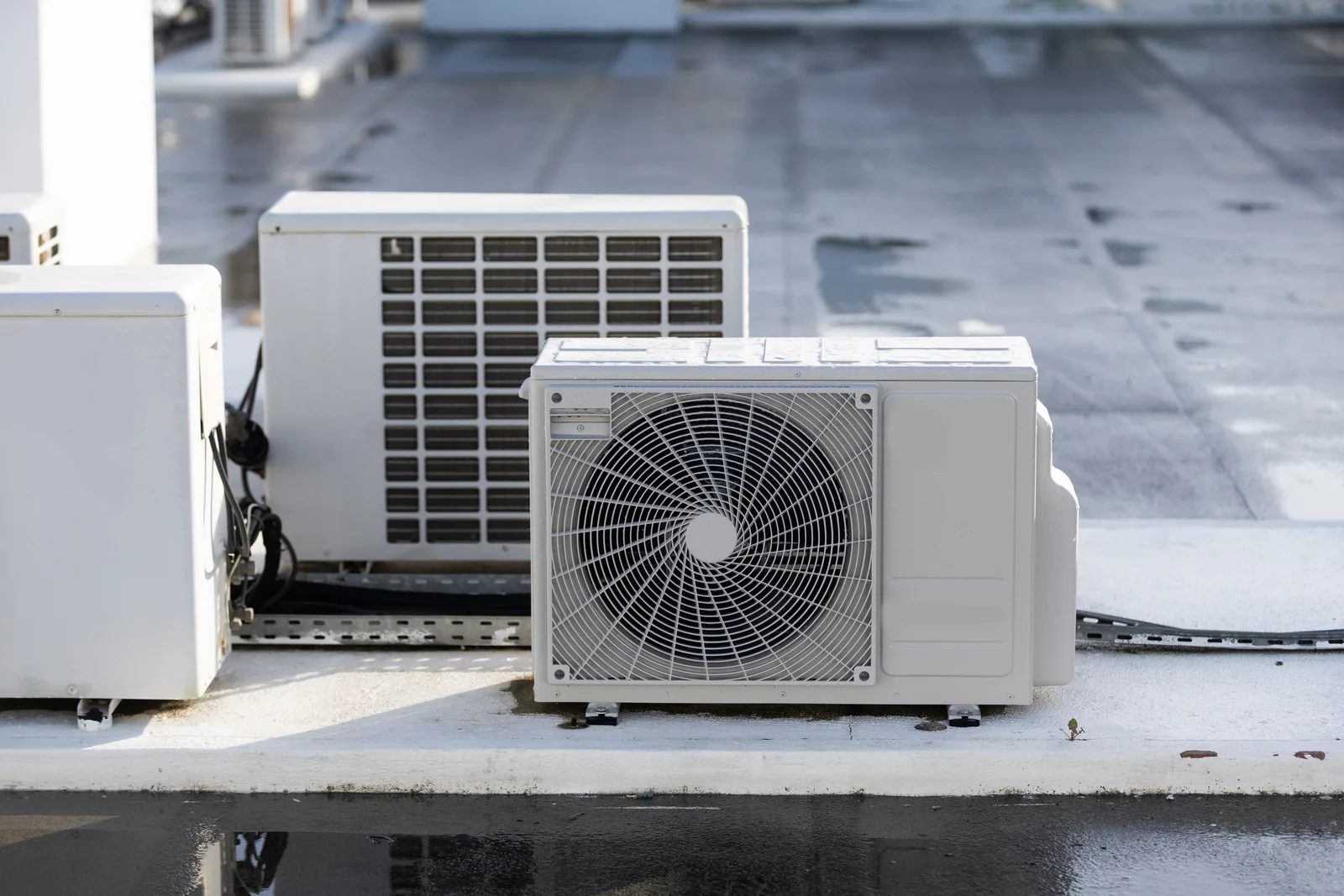
Duct, gas-furnace and rooftop losses across California’s coast and valley
The California claims we plan for follow gas heat, apartment housing, valley heat and the C-20 comp rule.
- A furnace vent that separates in a Los Angeles attic — carbon monoxide or a fire after a gas-furnace replacement is a completed-operations claim under general liability.
- A rooftop condensate line that backs up over a San Diego or San Jose apartment building — water travels into units below, third-party property damage under completed operations.
- A technician overcome by heat in a Fresno attic in July — the workers compensation claim every C-20 license already has to be insured for.
- A walk-in cooler that fails after a C-38 repair in San Francisco — spoiled stock at a restaurant or market becomes a property damage claim against the refrigeration contractor under general liability.
- Gauges and a recovery machine taken from a van in Sacramento — a contractors equipment loss, while an at-fault crash on a long valley route is a commercial auto claim.
What California C-20 and C-38 licensees hand us: the CSLB certificate, the bond and the job file
We start from the California license you hold. For a C-20 shop, the first job is keeping the workers’ comp certificate continuously on file with the CSLB under your license number, because the board suspends a C-20 license when coverage lapses and does not accept an exemption. For a contractor holding both C-20 and C-38, we describe comfort-cooling and refrigeration work separately so the policy fits both classifications. We keep the license bond and the liability program distinct, since a bond claim by a property owner or an unpaid employee is not an insurance claim, and we write completed-operations coverage that fits gas-furnace replacements on the coast, rooftop and heat-pump work in the valley, and walk-in refrigeration in the Bay Area.
Major California HVAC Markets
California is not one market — it is a vast Southern California, a mild San Diego coast, a temperate Silicon Valley, a cool Bay Area, and the hot Central Valley around Sacramento and Fresno, each with its own cooling load and service mix. These are the major HVAC submarkets we place across.
Los Angeles / Southern California
The largest metro market in the state spans mild coastal zones and hotter inland valleys, pairing a vast residential service base with heavy commercial-property and mechanical work. New install, changeout, and rooftop systems run alongside a deep service-and-replace market across a sprawling footprint.
San Diego
A mild, marine-influenced coastal metro with shoulder-season-oriented cooling demand and a steady residential service base, alongside commercial and mechanical work across the region. Milder climate shifts the mix toward service, replacement, and efficiency upgrades.
San Jose / Silicon Valley
A temperate South Bay metro where commercial, institutional, and technology-campus mechanical work is heavy, layered onto a strong residential replacement-and-service base in a generally mild climate.
San Francisco / Bay Area
A cool, marine coastal market where cooling load is lighter and commercial building-systems and mechanical work dominate, with residential service weighted toward replacement, ventilation, and efficiency rather than heavy cooling install.
Sacramento / Central Valley north
A hot inland capital region with a long, hot summer cooling season that drives heavy air-conditioning install, replacement, and service, alongside commercial and mechanical work across a fast-growing metro.
Fresno / Central Valley
A hot Central Valley hub where intense summer heat drives sustained cooling demand and a deep residential service base, with commercial, mechanical, and refrigeration work across an agricultural-region economy.
California is one of the 48 states we are licensed in. As each state page comes online you can compare licensing, season, and market conditions across every state we serve.
California HVAC coverage pages, in the order a C-20 shop needs them
Because a C-20 license cannot stay active without it, start with workers compensation. Next comes general liability and its completed-operations coverage, where Los Angeles furnace, coastal condensate and Bay Area walk-in claims land after the job. Contractors equipment covers recovery machines, gauges and equipment on the way to an installation, commercial auto covers vans on freeway and valley routes, and an umbrella matters when a Los Angeles or Bay Area commercial contract asks for higher limits. Coastal furnace and heat-pump service fits residential HVAC contractor insurance; rooftop, valley cooling and C-38 refrigeration fit commercial HVAC contractor insurance. To compare California with Nevada or Oregon, use the states we serve index.
California HVAC Insurance FAQs
Do California HVAC contractors need workers’ comp if they have no employees?
If they hold a C-20 license, yes. Under Business and Professions Code section 7125, the CSLB requires every active C-20 Warm-Air Heating, Ventilating and Air-Conditioning contractor to carry workers’ comp or a valid Certification of Self-Insurance whether or not it has employees, and a C-20 licensee cannot file the exemption other contractors use. The certificate must stay continuously on file; if coverage lapses, the license is suspended and work done during the suspension is unlicensed.
Which California license covers HVAC work, and when is a C-38 needed too?
The C-20 Warm-Air Heating, Ventilating and Air-Conditioning classification covers warm-air heating systems and water-heating heat pumps, ventilating systems and air-conditioning systems, with their ducts, registers, flues and controls, including solar-powered systems. Refrigeration is the separate C-38 classification, for refrigerators, refrigerated rooms and insulated spaces held below the temperature line in the regulation. A shop doing walk-in coolers as well as comfort cooling needs both the C-20 and the C-38, and its policy should describe both.
Is my CSLB contractor license bond the same as HVAC company insurance?
No. The license bond protects others from you: property owners, people harmed by a willful violation of a construction contract and employees owed wages can file claims against it, but the CSLB bond does not pay for damage your work causes the way general liability does. If the surety cancels the bond and no replacement reaches the CSLB in time, the California license is suspended.
How does a HERS inspection fit with insurance for a California HVAC job?
Under the California Energy Commission’s Home Energy Rating System program, HERS raters verify the work of licensed HVAC contractors for compliance with the Title 24, Part 6 Energy Code. Insurance responds to what happens if the work fails: damage your completed installation causes falls under general liability, while redoing work that did not pass verification is your own cost rather than a liability claim.
Do you write HVAC insurance in Los Angeles?
Yes. We place heating and air contractors across Los Angeles and San Diego as well as San Jose, San Francisco, Sacramento and Fresno. NOAA’s normals for Los Angeles International Airport show small heating and cooling loads on the coast, so Los Angeles programs lean on gas-furnace and heat-pump service in dense housing, while Central Valley accounts carry far heavier summer cooling work. The same C-20 comp rule applies in every California city.
Is a California HVAC maintenance crew covered while it services rooftop units?
Yes, if the program is built for it: workers’ comp covers the technicians’ own injuries, which every C-20 license must carry regardless of payroll, and general liability covers damage the crew’s work causes to the building or the tenants below. In the Central Valley, where Fresno Yosemite International Airport shows a far larger cooling load than the coast, summer maintenance means long rooftop and attic hours, so heat exposure is a central part of that crew’s comp picture.
Get a California HVAC insurance quote
Tell us how your California operation works — residential service, commercial and mechanical, or both — and we will market it to carriers that write the class.