States we serve · New Mexico
New Mexico HVAC contractor insurance
In New Mexico, holding a Construction Industries Division license is what triggers workers’ comp: a contractor doing work that the state’s licensing act covers needs comp regardless of its number of employees. We write the workers compensation, general liability, commercial auto, contractors equipment and umbrella a New Mexico HVAC company carries, matched to its MM-3, MM-2 or MM-98 classification and to the evaporative, gas and wood-heat work of a high-desert state.

New Mexico ties its HVAC rules together through one agency. The Construction Industries Division of the Regulation and Licensing Department licenses mechanical contractors by classification — MM-3 for heating, ventilation and air conditioning, MM-2 for natural gas fitting, MM-4 for hydronic and process piping, and MM-98 for the full mechanical scope — and certifies the journeymen who work under those licenses. That same license is what triggers workers’ comp: the Workers’ Compensation Administration requires comp of every employer engaged in work that the Construction Industries Licensing Act requires a license for, regardless of the number of employees. The equipment is distinctly regional. The MM-3 scope names evaporative cooling units alongside refrigerated air, and Census data show wood heat far more common in New Mexico homes than nationally, natural gas and propane more common too, electric heat far less common, and manufactured homes a far larger share of the housing. This page covers the CID classifications, the comp rule, the high-desert risk picture, the claims we plan for, and the New Mexico markets we place.
New Mexico HVAC insurance costs
New Mexico HVAC insurance is priced from your operation, not from a statewide rate card. For the drivers an underwriter weighs and how to get an accurate quote, see our guide to how much HVAC insurance costs in New Mexico.
MM-3 for air, MM-2 for gas, a separate license for propane: New Mexico’s CID classifications
Under the Construction Industries Division’s classification rule, 14.6.6 NMAC, the MM-3 Heating, Ventilation and Air Conditioning classification covers installing, altering, repairing, servicing and maintaining air-handling and refrigeration equipment and piping — fans, coils, condensing units, self-contained packaged heating and cooling units, evaporative cooling units, and ductwork, including solar air heating — with low-voltage controls, and lets the holder bid incidental structural or electrical work as long as a properly licensed contractor performs it. The MM-2 Natural Gas Fitting classification covers gas piping and fittings, hot-water heating systems within the rule’s size limits, steam and hot-water boilers, and warm-air heating systems with their chimney connections, flues and burners, but the MM-2 may not install LP gas systems, which sit under separate LP gas classifications. MM-4 covers hydronic heating and cooling, process piping, boilers, chillers, cooling towers and fuel oil tanks, and MM-98 indicates licensure across the MM-1 through MM-4 classifications at once.
New Mexico’s journeyman certificates follow the same map: a JR journeyman refrigeration certificate works under an MM-3 or MM-98 license and is issued only after the technician shows compliance with EPA refrigerant recovery requirements; a JG journeyman natural gas fitter works under an MM-2 or MM-98; and a JSM journeyman sheet metal certificate works under an MM-3 or MM-98. Our guide to EPA 608 certification as a business asset explains the federal side of that JR requirement. The carriers writing New Mexico HVAC policies are regulated by the New Mexico Office of Superintendent of Insurance (OSI).
Licensed under CILA, covered under comp: New Mexico’s rule for HVAC contractors of any size
New Mexico’s general comp rule turns on a minimum employee count, with part-time, seasonal and paid family workers all counted toward it. Construction is different. The Workers’ Compensation Administration states that employers actively engaged in activities required to be licensed under the Construction Industries Licensing Act, chapter 60, article 13 of the statutes, must carry workers’ comp regardless of their number of employees, and its Employer Compliance Bureau lists contractors licensed under that act, along with LLCs and incorporated businesses, among those who need coverage. An HVAC company working under an MM-3, MM-2 or MM-98 license is squarely inside that rule, so a very small shop that would fall below the general count in another trade still needs a comp policy in New Mexico. The Administration’s Employer Compliance Bureau enforces coverage, and the state keeps an Uninsured Employers’ Fund for injured workers whose employers did not insure. For a shop licensed under the Construction Industries Licensing Act, our workers compensation page explains how the policy pays when a technician is hurt.
New Mexico Seasonal Market
New Mexico spans high-desert and mountain elevations, so winters can be cold and heating-dominant at altitude while hot, very dry summers make evaporative (swamp) cooling a relevant and widely used option alongside conventional refrigerated air conditioning.
The honest framing: the New Mexico market is genuinely dual-season and elevation-driven, with a distinctive dry-heat twist. Cold high-desert and mountain winters make furnace, boiler, and heat-pump reliability a real demand driver, while hot, arid summers push cooling work — and because the air is so dry, evaporative (swamp) cooling is a common and relevant option alongside refrigerated air conditioning, so a New Mexico operation’s service mix often spans both technologies. That spread is why we weight each operation’s coverage to where and how it actually works rather than to a statewide average.
What evaporative cooling, wood heat and manufactured homes add to a New Mexico service call
NOAA’s normals for Albuquerque International Sunport put the state’s heating load well above its cooling load, while hot, very dry summers make evaporative cooling a working alternative to refrigerated air — so a New Mexico HVAC book mixes winter furnace work with summer cooler service. Each side has its own failure points. Evaporative coolers sit on roofs with water supply lines and pads, so a failed float, a cracked line or a pan left leaking after a spring start-up puts water through a ceiling, and rooftop work carries fall exposure for the technician. On the heating side, Census data show natural gas heating a larger share of New Mexico homes than nationally, propane more common as well, and wood heat far above the national share, so flues, venting and combustion appliances near wood stoves sit at the center of the carbon-monoxide and fire exposure. Manufactured homes make up a far larger share of New Mexico housing than nationally, with their own under-floor ducts and furnace closets. The diagram connects those New Mexico exposures to the coverage that responds: general liability for the install that fails after the job, contractors equipment for gauges and recovery machines, workers compensation for technicians on cooler roofs and in crawlspaces, and commercial auto for the long drives between Albuquerque, Roswell, Las Cruces and Farmington.
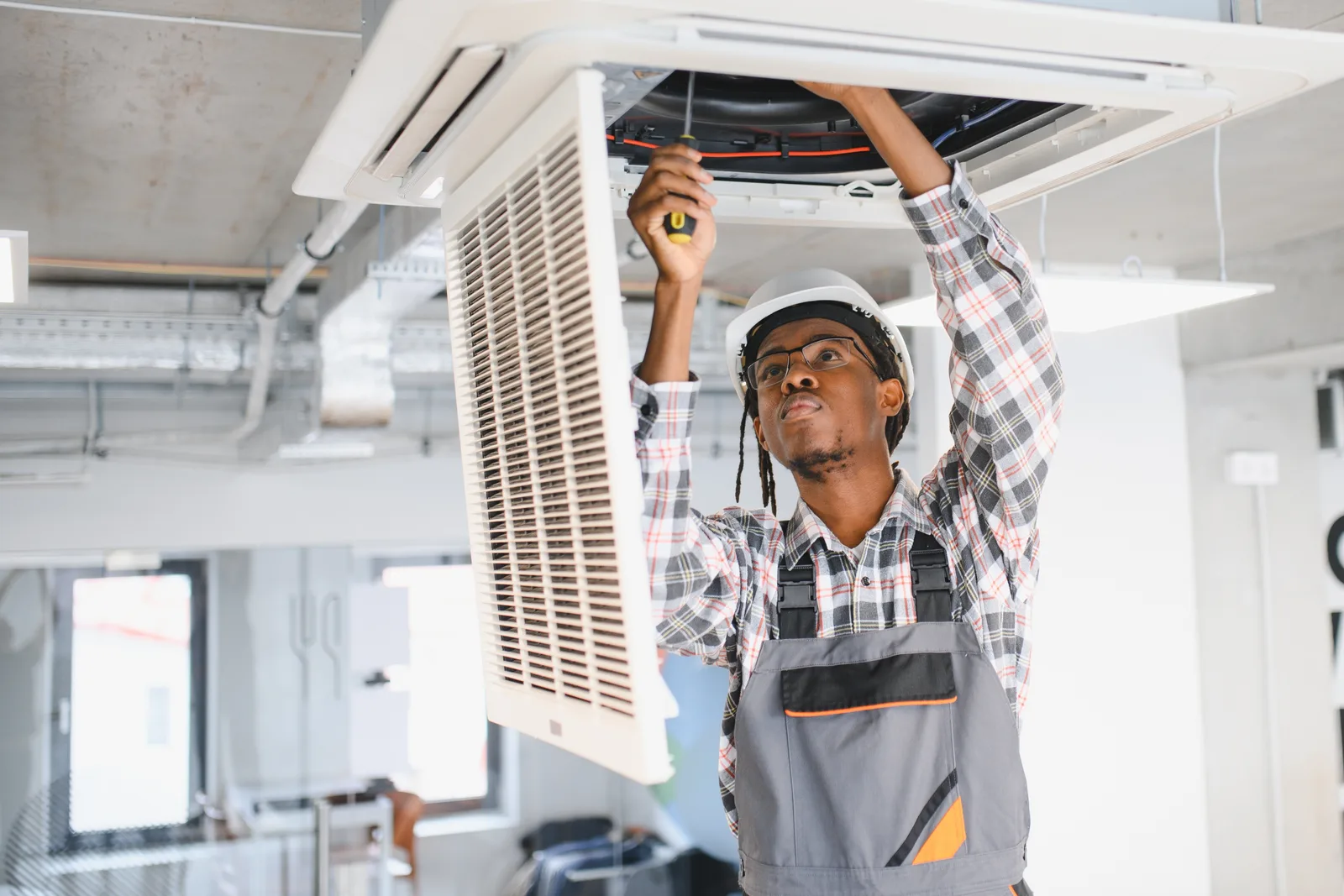
Albuquerque rooftops to Farmington propane lines: the New Mexico claims we plan for
These New Mexico losses follow the cooler on the roof, the fuel in the house and the comp rule for licensed contractors.
- An evaporative cooler that leaks into an Albuquerque ceiling — a supply line or float fails after a spring start-up and water damages the rooms below, a completed-operations claim under general liability.
- A furnace flue that separates in a Santa Fe house heated partly by wood — carbon monoxide or a fire after a gas-furnace replacement lands on general liability too.
- A propane connection that leaks after a rural call outside Farmington or Roswell — propane work falls under separate LP gas licensing from the MM-2, so we confirm who is licensed for it before the policy is written.
- A technician who falls from a Las Cruces roof while servicing a cooler — a workers compensation claim that New Mexico requires every licensed contractor to be insured for, however small the crew.
- Gauges and a recovery machine taken from a van in Rio Rancho — a contractors equipment loss, while an at-fault crash on a long state-highway run is a commercial auto claim.
Why New Mexico MM-3 and MM-98 holders pair their CID license with our comp and liability program
A New Mexico HVAC license brings a comp obligation with it, so we put workers’ comp in place for a CID licensee from the start, whether the company is one technician or a full crew. We describe your operations to match the classification you hold — MM-3 air handling, refrigeration and evaporative cooling, MM-2 gas fitting and warm-air heating, MM-4 hydronic and boiler work, or the full MM-98 scope — and we flag LP gas work that needs its own licensing. We check that your journeymen hold the certificates that fit under your license, write completed-operations coverage for cooler, flue and duct work in site-built and manufactured homes, and schedule the vans and gear that cover a state as spread out as New Mexico.
Major New Mexico HVAC Markets
New Mexico is not one market — it is a high-desert Albuquerque, a hot, dry Las Cruces and Roswell, a mountain Santa Fe, a fast-growing Rio Rancho, and a Four Corners Farmington, each with its own heating-and-cooling balance and service mix. These are the major HVAC submarkets we place across.
Albuquerque
The state’s largest metro sits at high-desert elevation, so cold winters drive heating work while hot, very dry summers make both refrigerated and evaporative cooling common. A deep residential service base runs alongside heavy commercial and mechanical work across its dense building stock.
Las Cruces
A southern New Mexico market with intense, dry summer heat where evaporative and refrigerated cooling both feature heavily, and mild winters keep heating secondary. Residential service and commercial mechanical work span an agricultural and university-anchored economy.
Santa Fe
A high-elevation capital where cold mountain winters make heating central and dry summers keep cooling demand real but moderate. Institutional, hospitality, and residential mechanical work define a market shaped by altitude and a distinctive building stock.
Rio Rancho
A fast-growing Albuquerque-area city where new residential and commercial construction drives install and changeout work. High-desert conditions create dual heating-and-cooling demand, with evaporative cooling a relevant option in the dry summers.
Roswell
A southeastern high-plains market with hot, dry summers and cool winters, so cooling service — including evaporative systems — leads while heating fills the cooler months. Residential service and commercial and agricultural mechanical work span a wide regional footprint.
Farmington / Four Corners
A northwestern high-desert and energy-sector market where cold winters drive heating work and dry summers sustain cooling demand. Residential service and commercial and industrial mechanical work span a wide, rural Four Corners footprint.
New Mexico is one of the 48 states we are licensed in. As each state page comes online you can compare licensing, season, and market conditions across every state we serve.
Further New Mexico reading on CID licensing, evaporative cooling and comp
Start with workers compensation, since New Mexico requires it of every contractor working under a CID license, then general liability and its completed-operations coverage, where cooler leaks, flue failures and manufactured-home duct claims land. Commercial auto covers vans on the long drives between the Rio Grande corridor, the Four Corners and the southeast, contractors equipment covers the recovery machines and gauges inside, and an umbrella helps when an Albuquerque or Santa Fe commercial contract asks for higher limits. Evaporative cooler, furnace and heat-pump work in homes fits residential HVAC contractor insurance; MM-4 hydronic, chiller and rooftop work fits commercial HVAC contractor insurance. To compare New Mexico with Arizona or Colorado, use the states we serve index.
New Mexico HVAC Insurance FAQs
What is New Mexico HVAC contractor insurance built around?
The CID license and the comp rule that comes with it. A New Mexico HVAC company is licensed by the Construction Industries Division under a mechanical classification such as MM-3, MM-2 or MM-98, and the Workers’ Compensation Administration requires comp of every employer doing work that the Construction Industries Licensing Act requires a license for, regardless of employee count. The program is then built from workers’ comp, general liability with completed-operations coverage, commercial auto, contractors equipment and an umbrella when an Albuquerque or Santa Fe contract calls for higher limits.
Does a one-person HVAC company in New Mexico need workers’ comp?
If it is doing work that requires a CID license, yes. New Mexico’s general rule turns on employee count, but the Workers’ Compensation Administration states that employers actively engaged in activities required to be licensed under the Construction Industries Licensing Act must carry comp regardless of their number of employees. LLCs and incorporated businesses are also on the Administration’s list of those that need coverage, with some exceptions.
Which New Mexico license covers evaporative coolers and refrigerated air?
The MM-3 Heating, Ventilation and Air Conditioning classification. Under 14.6.6 NMAC it covers air-handling and refrigeration equipment and piping, including condensing units, packaged heating and cooling units, evaporative cooling units and ductwork, with low-voltage controls. The MM-98 mechanical classification includes the MM-3 scope along with plumbing, gas fitting and process piping.
Can an MM-2 gas fitter in New Mexico install propane systems?
No. The MM-2 Natural Gas Fitting classification covers natural gas piping, boilers and warm-air heating systems with their flues and burners, but the rule says an MM-2 may not install LP gas systems, which fall under separate LP gas classifications. With propane heating more New Mexico homes than nationally, rural furnace work can involve both, and the policy should describe only the work your licenses allow.
What does a New Mexico journeyman refrigeration certificate require?
A JR journeyman refrigeration certificate is issued only after the technician demonstrates compliance with EPA refrigerant recovery requirements, and the holder works under an MM-3 or MM-98 license. Gas fitting and sheet metal have their own journeyman certificates — JG under an MM-2 or MM-98, JSM under an MM-3 or MM-98 — so each technician’s certificate should match the license the company holds.
Do you place HVAC contractor insurance in Albuquerque and across New Mexico?
Yes. We place heating and cooling contractors in Albuquerque, Rio Rancho and Santa Fe and out to Las Cruces, Roswell and Farmington. NOAA’s normals for Albuquerque International Sunport show heating well above cooling, and the hot, very dry summers make evaporative cooling a widely used option alongside refrigerated air, so Albuquerque programs carry both furnace and rooftop cooler exposure under the same CID license and comp rule.
Get a New Mexico HVAC insurance quote
Tell us how your New Mexico operation works — residential service, commercial and mechanical, or both — and we will market it to carriers that write the class.