States we serve · New Jersey
New Jersey HVAC contractor insurance
New Jersey writes insurance into the HVAC license itself: a Master HVACR contractor keeps its pressure seal, and can renew its license, only while a certificate of general liability insurance sits on file with the state board. We start a New Jersey program with the liability certificate the board requires, then add workers compensation, commercial auto, contractors equipment and umbrella for older, gas-heated, multi-unit housing.

New Jersey licenses HVAC work statewide under the State Heating, Ventilating, Air Conditioning and Refrigeration Contracting License Law, and the license is unusually tied to insurance. A Master HVACR contractor needs a state bond before taking on work, must file a certificate of general liability insurance with the board to obtain and keep its pressure seal and to renew its license, and must stamp that seal on every HVACR permit application — so a lapsed liability policy stops permits. The housing the license reaches is much older than the national median, two-to-four-unit buildings are close to twice as common as nationally, and Census data show utility gas heating a far larger share of New Jersey homes than nationally, with fuel oil also above the national share. This page walks the license and its insurance conditions, the gas-and-older-housing risk picture, the claims those conditions produce, and the New Jersey cities we write in.
New Jersey HVAC insurance costs
New Jersey HVAC insurance is priced from your operation, not from a statewide rate card. For the drivers an underwriter weighs and how to get an accurate quote, see our guide to how much HVAC insurance costs in New Jersey.
New Jersey’s Master HVACR license and the insurance built into it
New Jersey licenses HVACR contractors through the New Jersey State Board of Examiners of Heating, Ventilating, Air Conditioning and Refrigeration Contractors (Division of Consumer Affairs). The New Jersey Department of Banking and Insurance (DOBI) regulates the insurers and approves the surety behind the bond described below. The licensing law, codified at N.J.S.A. 45:16A, defines HVACR work broadly: boilers of every type, hydronic heating, furnaces and space heaters, refrigeration and cooling systems, ventilation and exhaust, mechanical ventilation for radon mitigation, and natural gas piping on the load side of the meter. A licensed entity acts through a bona fide representative — the owner of a sole proprietorship, a partner, an LLC manager or a corporate executive officer — who is the Master HVACR contractor.
Bond, liability certificate and pressure seal
Under section 45:16A-23, a Master HVACR contractor may not undertake HVACR work until it has entered into a bond in favor of the State, written by a surety authorized in New Jersey and approved by the Department of Banking and Insurance, renewed each year; no municipality may demand a similar bond. Section 45:16A-24 then makes general liability insurance a condition of the license: to obtain and retain a pressure seal and to renew, the contractor must file with the board a certificate of general liability insurance from an insurer licensed in New Jersey, or approved self-insurance, covering its HVACR contracting, and if that policy is cancelled or nonrenewed, it must file a certificate for the replacement before the old policy ends. Under section 45:16A-25, the pressure seal is surrendered on a finding of noncompliance with that insurance rule, and the seal must be impressed on every HVACR permit application. Section 45:16A-11 lets towns inspect and enforce standards but bars them from requiring a licensed Master HVACR contractor to hold another license, sit another exam or pay another licensing fee.
Refrigerant work alongside the state license
The Master HVACR license does not replace federal EPA Section 608 certification for technicians who handle refrigerant, even though New Jersey’s own definition of HVACR work covers the handling of refrigerants in stationary sources. Our guide to EPA 608 certification as a business asset covers the federal side.
Keeping a New Jersey pressure seal insured
Because the board holds your liability certificate, a New Jersey HVACR program has to be run on the board’s calendar as well as the carrier’s. We issue the certificate the board requires, line up the replacement certificate well before any cancellation or nonrenewal takes effect, and make sure the policy describes the full scope the license allows — boilers, hydronic work, gas piping on the load side of the meter and radon ventilation included. New Jersey comp is bought from private insurers rather than a state fund, and we write it around the way New Jersey crews work: boilers carried into the basements of older multi-family buildings, rooftop units in Newark and Jersey City, and emergency calls through the heating season. For commercial work, we set umbrella and additional-insured terms to what general contractors and property managers require.
Old, gas-heated, multi-unit: the New Jersey HVAC risk profile
NOAA’s climate normals for Newark Liberty International Airport put New Jersey’s heating load at several times its cooling load, though humid summers still bring a real air-conditioning season. The housing that load runs through is much older than the national median, with two-to-four-unit buildings close to twice the national share, and Census data show utility gas heating a far larger share of New Jersey homes than nationally, with fuel oil also above the national share and electric heat far below it. That combination concentrates risk in gas-fired boilers and furnaces, gas piping and venting inside occupied buildings, where one failed repair can reach several households, and in the oil burners that remain in older homes. The diagram lines New Jersey’s exposures up with the policies that pay: gas-piping, boiler and furnace work that fails after the job with general liability, the policy the board holds a certificate for; tools with contractors equipment; injured crews with workers compensation; and vans in dense traffic with commercial auto.
New Jersey Seasonal Market
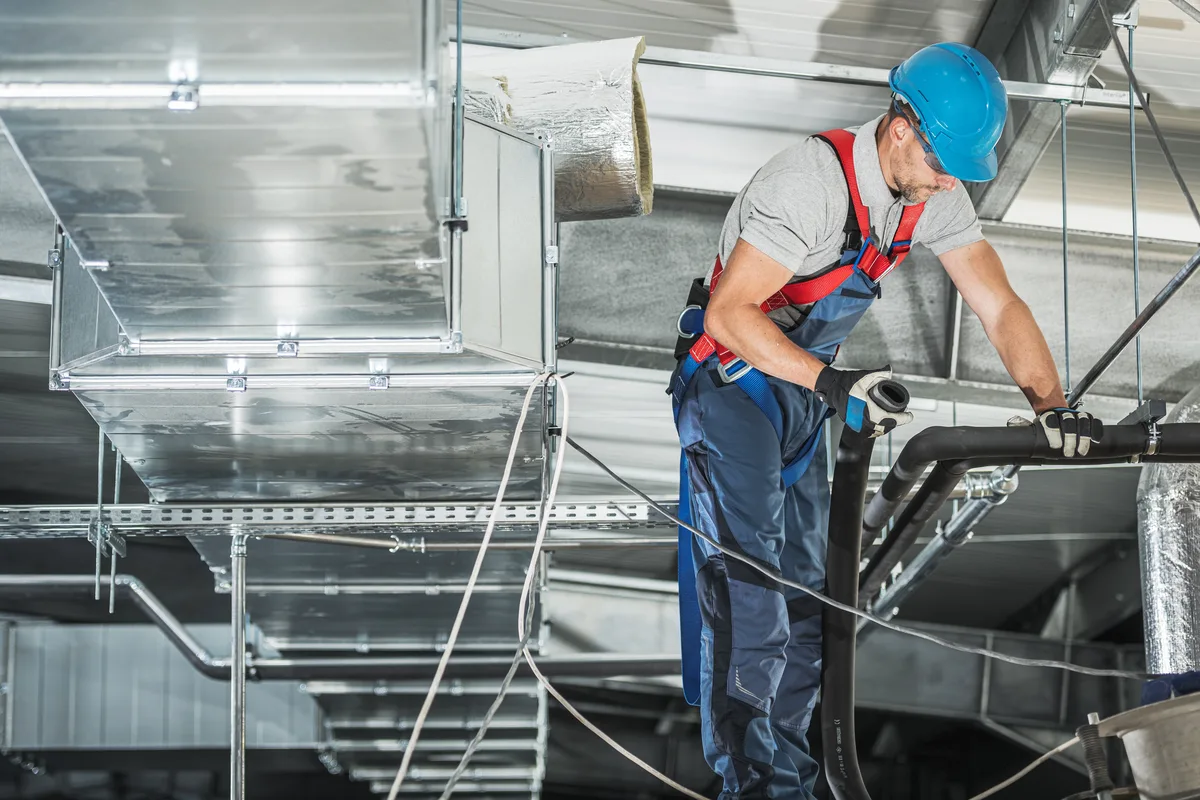
New Jersey is a four-season Mid-Atlantic market where humid, hot summers drive heavy cooling demand and cold winters drive sustained heating load, so HVAC work runs year-round across both heating and cooling systems.
The honest framing: New Jersey is a Mid-Atlantic four-season market, so HVAC demand is genuinely dual — humid summers keep air-conditioning install, replacement, and service busy, and cold winters keep furnaces, boilers, and heating systems in steady work. That balance is why we weight each operation’s coverage to how it actually splits between heating and cooling and between residential and commercial work rather than to a statewide average.
New Jersey HVACR claims we underwrite for
Gas heat, older multi-unit buildings and a license that reaches gas piping on the load side of the meter shape the New Jersey losses we plan coverage around.
- A gas line leak after a furnace or boiler swap. Gas piping the Master HVACR license covers, left with a loose fitting in a Paterson or Elizabeth multi-family, leads to a fire or an evacuation — completed operations under general liability, the coverage the board requires you to certify.
- A no-heat repair that fails in a multi-unit building. A boiler fix fails overnight and frozen pipes reach several units in a Jersey City two-to-four-family house — again general liability, with the umbrella above it.
- An emergency repair that causes water damage — a condensate line or hydronic fitting fixed on an after-hours call in Newark leaks into the ceiling below — a completed-operations claim.
- Tools taken from a van on a city street. Gauges and a recovery machine stolen from a service van in Newark or Camden — a contractors equipment loss.
- A technician hurt carrying a boiler — a strain or a fall on basement stairs in an older Trenton building — the workers compensation exposure; a van collision in Newark-area traffic is commercial auto.
Major New Jersey HVAC Markets
New Jersey is not one market — it is a dense northern metro corridor, a fast-growing waterfront, an institutional capital region, and a South Jersey base within the Delaware Valley, each with its own mix of residential service and commercial and mechanical work. These are the major HVAC submarkets we place across.
Newark
The state’s largest city anchors a dense urban service-and-replacement market alongside heavy commercial and mechanical work across office, institutional, and industrial buildings. Rooftop units and aging building systems keep both maintenance and changeout crews busy through every season.
Jersey City
A fast-growing waterfront metro with high-rise residential and commercial towers driving substantial mechanical, rooftop, and building-systems work. The dense, vertical building stock pushes demand toward commercial service contracts as much as residential replacement.
Paterson
An older, densely built city where aging heating and cooling systems sustain a steady residential service-and-replace base. Mixed-use and light-industrial buildings add a layer of commercial and mechanical work to the calendar.
Elizabeth
A port-adjacent industrial and commercial hub with warehousing, logistics, and mixed-use buildings that drive commercial mechanical and refrigeration demand. A dense residential base keeps service and replacement work steady alongside it.
Trenton
The state capital pairs institutional and government building-systems work with a residential service market across the surrounding metro. Four-season demand keeps both heating and cooling crews active year-round.
Camden
A South Jersey city within the broader Delaware Valley market, mixing commercial, institutional, and industrial mechanical work with a residential service-and-replacement base. Humid summers and cold winters drive dual heating-and-cooling demand.
New Jersey is one of the 48 states we are licensed in. As each state page comes online you can compare licensing, season, and market conditions across every state we serve.
Further New Jersey HVACR reading
Because the board holds your liability certificate, start with general liability and how completed-operations coverage follows a boiler, furnace or gas-piping job, and read how carbon-monoxide claims are handled if you vent gas or oil equipment. Multi-family work in New Jersey is the reason to size the umbrella carefully, and emergency condensate and hydronic calls make whether GL covers water damage from a failed condensate line worth reading. Gas-heat and boiler service fits residential HVAC contractor insurance, and multi-family and commercial mechanical work fits commercial HVAC contractor insurance; New York, Pennsylvania and the rest are listed on the states we serve index.
New Jersey HVAC Insurance FAQs
What makes an HVAC contractor licensed and insured in New Jersey?
Under the state HVACR licensing law it means a Master HVACR contractor license held through the business’s bona fide representative, a bond in favor of the State of New Jersey before any HVACR work is undertaken, and a certificate of general liability insurance filed with the State Board of Examiners of HVACR Contractors, which is a condition of holding the pressure seal and renewing the license.
Does a licensed and insured HVAC contractor in Union, New Jersey need a separate town license?
No. Section 45:16A-11 of the state HVACR law lets a municipality inspect HVACR work and enforce standards, but it bars any municipality, local board of health or other agency from requiring a licensed Master HVACR contractor to obtain an additional license, take another exam or pay a licensing fee. Section 45:16A-23 also bars towns from requiring their own bond. Permits still apply, and the pressure seal goes on every HVACR permit application.
What happens if a New Jersey HVACR contractor’s liability policy is cancelled?
Under section 45:16A-24, a Master HVACR contractor whose general liability policy is cancelled or nonrenewed must file a certificate for a new or replacement policy with the board before the former policy stops being effective. Under section 45:16A-25, the pressure seal must be surrendered on a finding of noncompliance, and because the seal is impressed on every HVACR permit application, a gap in coverage stops new permits.
What does emergency HVAC repair liability insurance cover for a New Jersey contractor?
The same general liability the board requires you to certify, including its completed-operations side. If a boiler, furnace or gas-piping repair you made on an emergency call in New Jersey later causes a fire, a gas leak, a carbon-monoxide injury or water damage, the third-party injury and property damage fall under that coverage. Repairing your own faulty work is treated separately, and a refrigerant release is a pollution question.
Does the New Jersey HVACR license cover gas piping and boilers?
Yes. New Jersey’s licensing law defines HVACR work to include power boiler systems, fire tube and water tube boilers, pressure steam and hot water boilers, hydronic heating, furnaces and space heaters, and natural or manufactured gas piping on the load side of a meter. Liquefied petroleum gas marketers licensed by the Department of Community Affairs are outside the Act, and other state licensees such as master plumbers keep working within their own scopes.
Who at a New Jersey HVAC company has to hold the Master HVACR license?
The bona fide representative of the licensed entity: the owner of a sole proprietorship, a partner in a partnership, a manager of an LLC, or an executive officer of a corporation. New Jersey’s HVACR law also bars a firm from operating under a license in the HVACR business until a valid license is secured or held by that representative, so an ownership or officer change is worth reviewing with the board and your insurer.
Get a New Jersey HVAC insurance quote
Tell us how your New Jersey operation works — residential service, commercial and mechanical, or both — and we will market it to carriers that write the class.