States we serve · Alabama
Alabama HVAC contractor insurance
Alabama’s Board of Heating, Air Conditioning & Refrigeration Contractors certifies HVAC and refrigeration contractors, and an active certificate requires a performance bond naming the Board, not an insurance policy. Alabama’s comp law applies at five employees — except for businesses building or working on-site on new single-family homes, which must carry it even below five. We write the general liability, workers compensation, commercial auto, contractors equipment and umbrella around the HACR certificate, the bond and the duct, heat-pump and new-construction work an Alabama shop does.

An Alabama HVAC business answers to a board of its own: the Alabama Board of Heating, Air Conditioning & Refrigeration Contractors issues two certifications — heating and air conditioning, and refrigeration — and a contractor who wants to work rather than hold an inactive certificate needs a business name and a performance bond with the Board as obligee. The bond is what a customer can claim against after a Board inspection finds a code violation; general liability, not the bond, is what protects the contractor. Comp follows a different line: Workforce Alabama requires coverage once a business has five or more employees, officers and LLC members counted, but a business constructing or assisting on-site with new single-family detached homes must carry it even with fewer than five employees. The housing and climate shape the rest: Census data show electricity heating a far larger share of Alabama homes than nationally and mobile homes a far larger share of the housing, and NOAA’s normals for Birmingham-Shuttlesworth International Airport show heating and cooling loads close to even. This page covers the certificates and bond, the comp rules, the heat-pump and duct exposures, and the markets from Huntsville to Mobile.
Alabama HVAC insurance costs
Alabama HVAC insurance is priced from your operation, not from a statewide rate card. For the drivers an underwriter weighs and how to get an accurate quote, see our guide to how much HVAC insurance costs in Alabama.
Two HACR certificates and a performance bond: what Alabama requires before the first job
Alabama certifies HVAC contractors through the Board of Heating, Air Conditioning & Refrigeration Contractors, and the examination a contractor takes decides the work. The heating and air conditioning contractor certification covers installation, service and repair of heating and cooling apparatus — forced-air systems, ventilation, gas piping, mini-splits, heat pumps and central systems — but not window units or automotive and farm-implement equipment. The refrigeration contractor certification covers commercial refrigeration used for purposes other than human comfort, such as walk-in and reach-in coolers and refrigerated storage. After passing, a contractor chooses a status: active, for contractors who perform the work, which requires a business name and a performance bond naming the Board as obligee on the Board’s bond form; or inactive, which needs no bond but does not allow the work. Alabama law bars anyone from advertising, bidding, obtaining permits or performing as a certified contractor unless the person in responsible charge is certified, requires the certification number and company name on documents, advertising and every service and installation vehicle, and bars a local official from issuing a business license to an HVAC contractor without seeing the Board’s certificate. Counties and cities may not require further local testing of a certified contractor beyond their privilege, license or business fees. The Board accepts reciprocity applications from licensees of named boards in Mississippi, Tennessee, Ohio, South Carolina, Texas, West Virginia and Louisiana. Carriers writing Alabama HVAC policies are regulated by the Alabama Department of Insurance.
Duct subcontractors, duct testers and LP-gas work
The Board’s rules let a certified heating and air conditioning contractor who bids an installation and is responsible for its permits subcontract the duct work — and only the duct work — to an uncertified person working under its supervision, and the certified contractor stays responsible for that work if it fails the Board’s minimum standards. Anyone who tests or verifies duct air tightness must register with the Board, and a certified contractor registering as a tester must complete one of the approved trainings. Gas appliance work can involve a second regulator: Alabama Liquefied Petroleum Gas Board licensees are exempt from the HACR law for LP-gas appliances not connected to a refrigeration system, and the LP-Gas Board’s Class C permit application, posted on the HACR Board’s forms page, asks for a certificate of insurance showing minimum liability coverage. Neither Alabama certification replaces the federal credential a technician needs to handle refrigerant; see EPA 608 certification as a business asset.
Five employees, or fewer on a new-house site: Alabama’s comp line for HVAC crews
Workforce Alabama, the state agency that runs the workers’ comp division, sets the general line at five: a business with five or more employees — full-time or part-time, including corporate officers and LLC members — must carry workers’ comp, and one that regularly employs fewer is not required to under the general rule. The exception reaches straight into HVAC work. Businesses involved in constructing or assisting on-site with new single-family, detached residential homes are required to maintain coverage even with fewer than five employees, so an Alabama shop that sets equipment and runs duct in new houses should treat comp as mandatory at any headcount below the general line. Employers can buy coverage in the voluntary market through an agent, from the assigned risk pool that NCCI administers after carriers decline the risk, through a group self-insurance fund, or by qualifying to self-insure, and the Alabama Department of Insurance approves the carriers and policies. Workforce Alabama lists comp as the exclusive remedy for on-the-job injuries, which is why a small shop working below the general threshold still weighs it; our workers compensation page explains how the policy responds.
Alabama Seasonal Market
Alabama runs a long, hot, humid cooling season alongside a real heating season, so HVAC work carries both air-conditioning and heat-pump demand and winter heating service.
The honest framing: Alabama carries a real heating season alongside a long, humid cooling season, so neither air conditioning nor heating is the side of the calendar a program can ignore. The Gulf Coast around Mobile runs warm and humid with near-continuous cooling and dehumidification demand, while the inland metros layer heavy residential service onto growing commercial and mechanical work. That spread is why we weight each operation’s coverage to where and how it actually works rather than to a statewide average.
Birmingham degree days, electric heat and mobile homes: the Alabama exposure picture
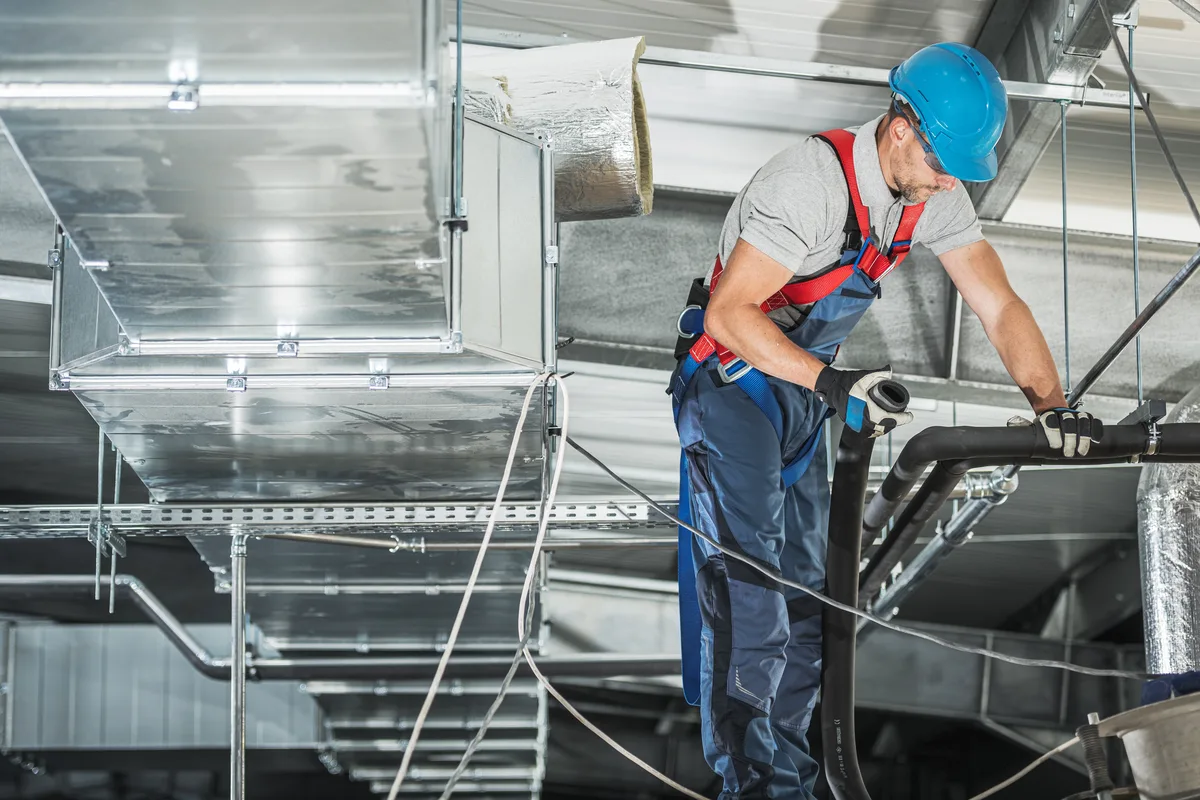
NOAA’s climate normals for Birmingham-Shuttlesworth International Airport put annual heating and cooling degree days close to even, with heating slightly ahead, so an Alabama heat pump works hard in both seasons rather than only in the humid summer. Census data show electricity heating a far larger share of Alabama homes than nationally and utility gas a far smaller one, mobile homes making up a far larger share of the housing than across the country, and a median year built newer than the national median. That puts Alabama exposure in heat-pump installs that fail in a cold snap or a heat wave, belly and crossover ducts under manufactured homes, air handlers and condensate lines in attics, and electrical faults on all-electric systems. The diagram below maps those exposures to the policies that answer them: a failed install to general liability completed operations, gauges and recovery machines to contractors equipment, crews on new-home sites to workers compensation, and vans between Huntsville and Montgomery to commercial auto.
Alabama ductwork, heat-pump and bond-complaint losses
These are the loss patterns we plan Alabama programs around, each tied to the Board’s rules, the comp line or the housing above.
- A duct subcontractor’s work that fails inspection — the HACR rules keep the certified contractor responsible for duct work it subcontracts, so leaks, crushed runs or disconnections after the job land on the certified shop’s general liability.
- A crossover duct that separates under an Alabama mobile home — manufactured homes are a far larger share of Alabama housing than nationally, and moisture and floor damage after the install is a completed-operations claim.
- A consumer complaint that turns into a bond claim — after the Board’s compliance officer finds a minimum-standard violation, the customer may pursue the contractor’s bond or direct payment in an amount the Board sets, while property damage from the faulty work is a liability question.
- A heat pump that fails in a Birmingham cold snap — with heating and cooling loads close to even at Birmingham-Shuttlesworth International Airport, a failed defrost control or wiring fault can mean frozen pipes in winter as easily as a hot house in summer.
- A helper hurt on a new-home site in Huntsville — Alabama requires comp for businesses working on-site on new single-family homes even below five employees, so an uninsured small shop has no threshold to shelter behind; see workers compensation.
- Stolen gauges or a van accident between Mobile and Montgomery — contractors equipment and commercial auto, with the Board’s certification number displayed on every service vehicle.
Bond, certificate number and new-construction comp: our Alabama HACR program
We start with your HACR certification — heating and air conditioning, refrigeration, or both — and describe your operations to carriers to match it, since a refrigeration contractor’s walk-in cooler work and a heating contractor’s heat-pump installs are different risks. We keep the performance bond naming the Board in view alongside the liability policy, because the bond answers Board-ordered consumer claims and the policy answers damage to property and people. If you subcontract duct work under the Board’s rule, we write your completed-operations coverage knowing that work stays yours. If your crews work on new single-family homes, we write comp even if you have fewer than five employees, as Workforce Alabama requires for that work, and for LP-gas appliance work we provide the certificate of insurance the LP-Gas Board’s Class C application asks for.
Major Alabama HVAC Markets
Alabama is not one market — it is an industrial Birmingham, a capital-region Montgomery, a humid Gulf Coast at Mobile, a fast-growing Huntsville, and university metros at Tuscaloosa and Auburn, each with its own cooling load and service mix. These are the major HVAC submarkets we place across.
Birmingham
Alabama’s largest metro pairs a hot, humid cooling season with a deep residential service-and-replacement base and substantial commercial and mechanical work across its medical, office, and industrial corridors. Sustained air-conditioning load keeps crews busy through a long summer.
Montgomery
The capital region runs a long, hot cooling calendar that drives steady residential air-conditioning service alongside government, institutional, and commercial mechanical work. Heat-pump systems feature across both the residential and light-commercial mix.
Mobile
A Gulf Coast metro where heat and coastal humidity push near-continuous cooling and dehumidification demand. The market blends a steady residential service base with commercial, refrigeration, and mechanical work along the port and coastal corridor.
Huntsville
A fast-growing North Alabama metro where aerospace, technology, and master-planned growth drive heavy new-construction and retrofit mechanical work, rooftop units on commercial buildings, and a large residential replacement-and-service market.
Tuscaloosa
A West Alabama market with hot, humid summers that sustain residential air-conditioning service, paired with university, institutional, and commercial mechanical work across the metro.
Auburn
An East Alabama university region with a long cooling season and a growing residential service base, alongside commercial and light-mechanical work across the metro and its surrounding communities.
Alabama is one of the 48 states we are licensed in. As each state page comes online you can compare licensing, season, and market conditions across every state we serve.
Alabama reading for HACR certificate holders and duct subcontractors
Because the HACR rules keep subcontracted duct work on the certified contractor, start with completed-operations coverage and condensate water-damage claims, then what general contractors require from HVAC subs for Alabama new-home builders’ contracts. Crews working below the five-employee line should read workers compensation with the new-home exception in mind, and whether insurance covers tools stolen from a van covers the gear on an Alabama route. Heat-pump and duct installers from Huntsville to Mobile will find their program on residential HVAC contractor insurance, refrigeration contractors on commercial HVAC contractor insurance, and the Board’s reciprocity states on the states we serve index.
Alabama HVAC Insurance FAQs
Does ductwork insurance cover duct work I subcontract on an Alabama job?
Your general liability does, because the work stays yours. Alabama’s HACR rules let a certified heating and air conditioning contractor who bids an installation and pulls its permits subcontract duct work only to an uncertified person working under its supervision, and the certified contractor remains responsible if that duct work fails the Board’s minimum standards. Ductwork insurance for an Alabama shop is the completed-operations coverage in its general liability policy, written to include that subcontracted work.
Is an Alabama HACR performance bond the same as liability insurance?
No. An active HACR certification requires a performance bond naming the Board as obligee, and after a Board compliance officer finds a minimum-standard violation, the customer may pursue a claim on that bond or direct payment from the contractor. The Alabama bond protects the customer; it does not pay for property damage or injuries your work causes. That is general liability, which the Alabama HACR law and rules do not require but general contractors and commercial customers can ask to see.
Does a small Alabama HVAC shop working on new homes need workers’ comp?
At five employees, or sooner for new-home work. Workforce Alabama requires coverage for a business with five or more employees, counting part-time workers, corporate officers and LLC members, but businesses involved in constructing or assisting on-site with new single-family, detached residential homes must maintain coverage even with fewer than five employees. An Alabama HVAC shop that installs systems in new houses should plan on comp below the general threshold too.
Do you insure HVAC contractors in Athens, Alabama?
Yes. We place HVAC contractors in Athens, Alabama, and across the Huntsville area and the rest of the state. The same HACR certification applies statewide, Alabama cities and counties may not require further local testing of a certified contractor beyond their privilege, license or business fees, and the local official issuing your business license must first see the Board’s certificate.
Is there heat pump insurance for Alabama HVAC installers?
Heat pump insurance for an Alabama installer is the completed-operations part of general liability, plus contractors equipment and workers compensation, and it matters because Census data show electricity heating a far larger share of Alabama homes than nationally. NOAA’s normals for Birmingham-Shuttlesworth International Airport also put the heating and cooling loads close to even, so a heat pump you install carries the house through both seasons and can fail in either.
What does an Alabama HACR certificate holder have to show on company vans?
The certification number and company name: Alabama law requires every licensed HVAC and refrigeration contractor to display both on all documentation, all advertising and all service and installation vehicles, and it bars a certified contractor from letting anyone else use the license. For an insured company, keeping the name on the vans consistent with the name on the policy and the Board’s records also keeps commercial auto and certificates simple.
Get an Alabama HVAC insurance quote
Tell us how your Alabama operation works — residential service, commercial and mechanical, or both — and we will market it to carriers that write the class.